
I have never met anyone who had never made a mistake. I did hear about one person who said he thought he had made a mistake once, but he was wrong! For  the rest of us, making mistakes goes right along with the risks that are a natural part of life. Little children routinely make mistakes as a part of learning to play. Kindergarten and first-grade teachers keep extra clothes because often children make mistakes about bodily functions and the frequency of needing to use the bathroom.
Learning things like arithmetic and spelling as well as sounding out words while learning to read involve trying, which consists of a combination of success and the making of mistakes. Discovering those things that tend to lead to more victories than errors helps us figure out the direction in our lives that lead to the most satisfaction. As we move through life, both the consequences of our mistakes and the positive outcomes of our success should combine to form the people we come to be as adults.
As we move through the teen years and into adulthood, more and more of the things that happen in our lives depend on the choices we make. We choose the friends we associate with, the activities we invest our time and energy in and the direction our life rakes as we reach the point where the decisions and the outcomes we experience are ours.
As behavior patterns and habits become established in us as adults, we will continue to make mistakes. While the premise behind our making mistakes while growing up was that we would learn from our mistakes and grow from having made them, we find that often as adults our mistakes become ingrained patterns of behavior. It would be easy to assemble a list of errors people make over and over, seemingly learning nothing from them. Take a minute and ask yourself what mistakes of that type are part of your life. What do you do over and over, telling yourself you will change?
Are there things you have resigned yourself to in your life? There is no benefit to be obtained from these mistakes. Their outcome is predictable. Making the same mistakes over and over can lead to discouragement and boredom. We might even come to the point of merely being resigned to living a life we believe we are powerless to change. Is there any part of your life that feels like that?
 At specific points in our lives, we may want to consider making the kind of changes that seemed so exciting earlier in our lives. Now that we are more mature and hopefully wiser, we may see once again a vision of what is possible. What might happen if we were to make one or more of these changes? Many things might happen.
One thing that is apparent is that we will make mistakes. When we try new things, some will work and some won’t. The critical thing in this circumstance is to create different blunders. Make mistakes from which we will learn and grow. Make new mistakes from which lives–ours and others’ will be better.
As we move forward, let’s resolve to learn from and be guided by the past. Let us decide not to be limited by the past. I honestly believe I have learned more from the mistakes I have made than from the things I have done right. As I look to the future, I am excited about the possibilities. I want as many of the mistakes I will make to be new ones, mistakes from which I will learn and grow. I hope I never become discouraged about past mistakes or afraid of creating new ones. I hope you feel the same way.
If you would like to receive new As We Move Forward posts, please subscribe to the As We Move Forward mailing list by clicking here. I release entries on a bi-weekly basis.We have a podcast containing the As We Move Forward articles read by Jae Bloom.
 We all know that the only moment we have is the one we are in presently. We may wish to, but we cannot relive the past, and despite hoping and planning and even wishing, the future is still just that—the future. It has not come, and when it does arrive, it is often much different than we thought it would be.
 As a way of living in the present, look at your life concerning what has gone before and what you think or hope will come after. Start with some easy comparisons, especially if there are some painful memories from your past or some real or imagined fears about what the future might hold for you. Given that today is the reality each of us has, how can we make the most of right now. How can we live the best today possible?
 None of these explains thoroughly why each of us becomes the person we develop into, but these and other factors present in the early relationships over which we often have little or no control seem to guide and inform the choices we make for the relationships we have some say in forming.
 Mutual recognition and acceptance of people we do not agree with can be a challenge. A fundamental willingness to agree to disagree can be the basis for a satisfying relationship with someone whose ideas are different than ours. One of the more difficult aspects of this type of relationship is to keep harsh judgment and the struggle to exert power out of the relationship. It is hard and painful to stay in a relationship built on conflict and the willingness to inflict hurt for the sake of maintaining power over someone.
 Sadly, that can also happen in relationships we thoroughly enjoy. It
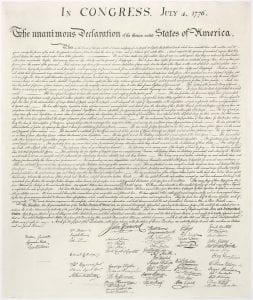 The opening words of the Declaration of Independence are among the most powerful words ever written. They speak to the fact that certain truths are fundamental to the basic understandings that both individuals and societies have about themselves. We are learning truth from the moment we are born-some theorize even before that. The nature of the truths we embrace and believe is shaped by those influences, both people and circumstances, that make up the world around us.
 If you were writing the Declaration of Independence and had finished the beginning of the phrase, “We hold these truths….”, what would your list include? Can you list any other truths that you think others would agree with you are basic and essential enough to have a revolution over? Do you think most people agree with the three in this original document?
 We will not always agree with everyone in our lives about what truth us. We live in a time when that seems elusive for many people. The most we can hope for in cases of disagreement is honest discussion of our differences, based on mutual respect and a shared desire for understanding.
 Why do you get up each morning and do what you do each day? On the surface, that may seem like an obvious question. Looking a little deeper into what is going on within us as we move through our days can help us gain a deeper understanding of the why behind some of our basic and most routine actions. It is likely your day’s activities are driven by a number of factors. Choices you have made at various times in the past may determine where you live, where you do the thing you have chosen to fill the majority of your time. How you feel about any and all of these factors in your life will play a bit part in your motivation to do the things that you do to occupy your day.
 live each day to its full potential.
 Are you basically a happy person? Would others describe you as happy? Even happy people struggle and get discouraged. A lot of understanding about our motivation can be learned by honestly looking at that aspect of life.
 How we resolve the things that confront us in our lives is directly related on our response in these situations. Since our responses are determined by our character, it really matters what our character is. It has been observed that certain character traits seem to be identified with positive outcomes while others seem to be present when the outcome is negative. While there is not a hard and fast connection between character traits and outcomes, the tendencies are real. It cannot be said good people are always more successful than bad people, although the trends do exist.
 Many people believe character can be developed and that we can train ourselves to be stronger in demonstrating certain behavior characteristics. Benjamin Franklin had a
 It is essential to every person to have a sense of belonging. The model of the family forms the ideal environment for a person to find love, protection, nurture, education and so much more. For the rest of our lives, we seek ways to belong. The things we do to belong say a lot about who we are and what is really important to us.
 Having a relationship with a sense of belonging includes respect but goes beyond that. The essence of a relationship that brings with it the sense of belonging keeps coming back to essentials like core values and beliefs. I feel safe around people with whom I share core values, like honesty and integrity. I can disagree with people in this type of relationship as long as our mutually held values and beliefs are not violated.
 The same can be said of a country. Our sense of belonging to our country is directly related to how we believe these values to be a reflection of our own. When that does not occur or is disrupted, we may experience a sense of isolation and frustration. In a country as diverse as ours, it can sometimes be difficult to experience a sense of belonging. This is even more difficult in a time like this when modern communication sources give us so much information it can at times come across as information overload.

 Most of us would agree we seem to live in a world so complicated that achieving balance in our lives sometimes appears to be overwhelming. As we move forward, our ability to recognize the factors that affect the balance in our lives and the lives of those around us becomes a vital skill to live our lives to their full capacity for fulfillment, satisfaction, and happiness. The best to each of you as you seek to have and maintain a balanced life.
 I don’t know many people who experience life without setbacks. I do remember a conversation many years ago with someone who expressed concern that her family had not suffered any real hardships. She was afraid of what she would do if anything terrible happened to them. I have reflected on this conversation many times over the years as I have watched people experiencing troubling situations. After going through some difficult times, I can understand her apprehension. The lessons we learn and the maturity we develop while working through difficulties helps us develop strategies and resources for dealing with future setbacks.
 Facing challenges, especially with most or all of the fear removed, can make us open to new possibilities. Being forced out of our comfort zone can lead us in directions we might never have considered without being faced with the setback. Far too many people come to a seemingly insurmountable obstacle and just stop there. They may live out the rest of their lives with that setback being the thing that defines and dominates their life.

 The process of always being right before going ahead can, at times, be painful. It may put you in opposition to people close to you. Are you facing a decision where taking the time to be sure you’re right before you go ahead would help you commit to the course of action the decision calls for?